PIP claim help from Waterford to West Branch—and across Michigan.
A delayed benefit payment can affect treatment, income, and help at home. I review the applicable policy, claim records, and insurer’s explanation to help Michigan crash victims understand their options when no-fault benefits are disputed.
Work directly with Steve Hanft, an attorney at Bagley & Langan, PLLC in Waterford with ongoing ties to West Branch. Request a free consultation or call (989) 942-0951.

Your benefits. Your recovery.
Michigan no-fault insurance can provide personal protection insurance (PIP) benefits after a qualifying crash, regardless of who caused it. You generally turn to your own auto insurer, although priority rules and eligibility exceptions can put responsibility with another insurer.
Knowing which insurer should pay is the beginning. The benefits, supporting records, and deadlines each need attention.
Medical care & rehabilitation
PIP medical may cover reasonably necessary treatment and rehabilitation, subject to applicable coverage limits, coordination, exclusions, and payment rules. Your medical selection matters: limited coverage, an exclusion, or an opt-out can change what is available.
Wage loss
When crash injuries prevent you from working, work-loss benefits generally replace 85% of qualifying lost income during the first three years after the crash, subject to a monthly statutory maximum and other adjustments. Employment records and medical support help establish the loss.
Replacement services
Help with ordinary household tasks you would have done yourself—such as cleaning or laundry—may qualify for reimbursement, generally up to $20 per day for the first three years. Document who helped, when, and what they did.
Attendant care
Personal assistance with needs such as bathing, dressing, or supervision may qualify when reasonably necessary for your injuries. Care needs, hours, provider arrangements, and applicable limits require individual review.
Case management
Complex injuries can involve multiple providers, appointments, and care needs. Reasonably necessary case management may be part of your benefits; the service and its connection to your recovery must be supported.
A lower premium.
What protection did you give up?
The 2019 reforms changed Michigan’s longstanding unlimited-medical system by allowing selected medical limits and qualifying exclusions or opt-outs. The law also required PIP premium reductions. A lower bill, however, does not mean the medical protection you gave up has been replaced.
STEVE’S PERSPECTIVE“I view medical limits and opt-outs as cost-saving mechanisms for insurers: less medical exposure for the company can leave more risk with the injured person. I want you to understand that tradeoff before an accident—not discover it afterward.”
Before an accident: don’t opt out of medical protection.
My recommendation is to keep PIP medical coverage rather than opt out. If you still have the opportunity to review your coverage before a crash, discuss retaining or restoring it with your licensed insurance agent. Make sure you understand what your health coverage does—and does not—replace.
A policy change for the future does not rewrite the coverage in force for an accident that already happened.
Think twice before giving up medical protection.
This marked-up example highlights the medical exclusion choice Steve recommends reviewing carefully before an accident. Read it alongside the complete selection form below.
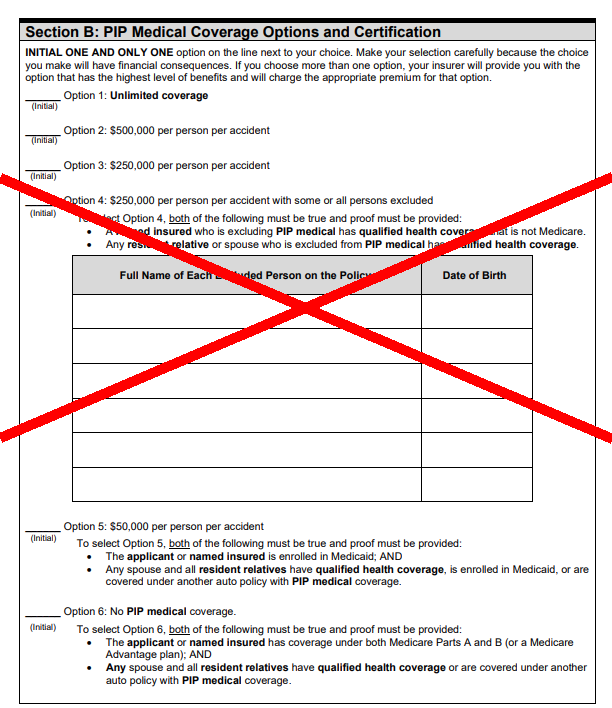
Your PIP medical selection form.
See the complete six-page Michigan PIP medical selection form for individuals, including coverage choices, exclusions, eligibility, and the acknowledgment you are asked to sign.
View the complete six-page form
Complete form supplied by Steve · 2025 edition · 6 pages. If the viewer does not display on your device, use Open full form. This blank reference form does not submit a coverage election; review the applicable form and coverage with your insurer or agent.
Already injured with a medical opt-out?
Talk with me before assuming there is nothing to pursue. I can review the election, eligibility, household coverage, and the circumstances of the crash. The wording on a declarations page is not the entire investigation.
- Medical expenses: evaluate health coverage, the validity and scope of the exclusion or opt-out, and potential medical-expense claims against responsible parties.
- UM/UIM coverage: review the policy’s definitions, exclusions, offsets, and conditions to determine how the medical election affects the losses that may be claimed. UM/UIM is not an automatic replacement for waived PIP medical.
- Protect the sequence: coordinate the liability and insurance claims, including any required written consent before settling with or releasing the at-fault party.
These situations require an individual review. I help connect the medical, liability, and UM/UIM questions so they are considered together.
Explore PIP choices on the sample dec pageA friendly voice still represents the insurer.
The claim representative may sound helpful—and may be courteous—but their role is to evaluate the company’s obligations and manage its claim costs. They do not act as your attorney or advocate.
Don’t go it alone. Let’s review requests, unpaid benefits, and proposed decisions before they shape your claim.
Who is looking out for your care?
Don’t assume you must simply accept a case manager suggested by the insurance company. Before agreeing, talk with me about an independent case manager, who they report to, and whether their role serves your recovery. Provider selection, medical necessity, and coverage should be reviewed together.
How I help
I review the applicable coverage, identify disputed benefits, help organize supporting documentation, and address delays or denials. The goal is to give you an informed advocate while you focus on getting better.
References & legal context
- Michigan DIFS — 2019 reform and implementation
- Michigan DIFS — PIP medical choices
- MCL 500.3135 — Potential tort recovery of medical expenses
- MCL 500.3107 — No-fault benefit categories
- Michigan DIFS — Auto insurance questions
- Michigan DIFS — Attendant care guidance
General information, not legal advice. Eligibility, coverage, deadlines, and available damages depend on the law, policy terms, and facts. Reviewed October 22, 2026.